Restoration Process
Understanding Power Restoration After an Outage
At New-Mac Electric Cooperative, we work hard to keep our members informed and prepared when power outages occur. One of the most common questions we receive is, "Why does my neighbor have power when I don't?"
The answer lies in the restoration process.
Electric cooperatives follow a standard restoration procedure designed to restore power to the greatest number of members in the shortest amount of time. While every outage is unique, the overall approach remains the same.
When an outage occurs, crews first focus on repairing the main distribution line. This line serves as the backbone of the electrical system and supplies power to multiple sections of the grid. Until the main line is restored, repairs farther down the system cannot restore power to members.
Once the main line is repaired, crews can identify and isolate additional damage throughout the system. From there, restoration efforts move to tap lines, which serve smaller groups of homes, farms, and businesses. Repairing these lines often restores power to multiple members at once.
Finally, crews address individual service lines that connect power directly to a single home or building. This is why you may see a nearby neighbor regain power before your home does. In some cases, the damage may be isolated to the service line serving your property.
During major outages, you may notice crews driving past your home several times before work begins in your area. Rest assured, they are following a carefully planned process designed to restore power to as many members as possible, as quickly and safely as possible.
When outages occur, our crews work around the clock because we understand how important electricity is to your daily life. We appreciate your patience and understanding as restoration efforts take place.
If you experience a power outage, please report it by calling New-Mac Electric Cooperative at (417) 451-1515.
Step 1
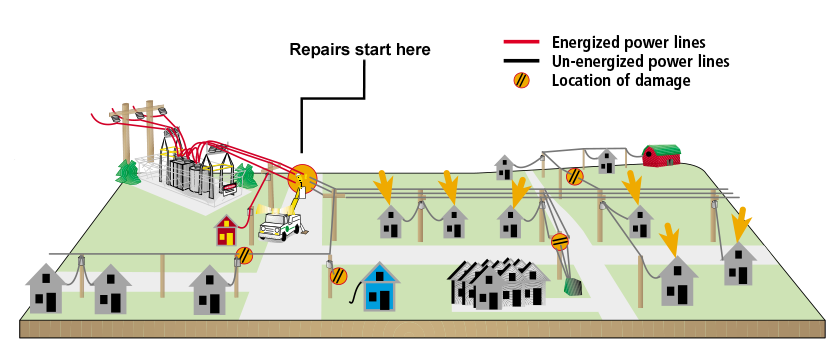
The substation is energized but a main distribution line is damaged near the substation, leaving most members without power. All repairs start with the main line. A large number of members (shown with orange arrows) will have power returned once the main line is fixed. All other repairs would be pointless until this line is restored as it feeds all the other lines.
Step 2
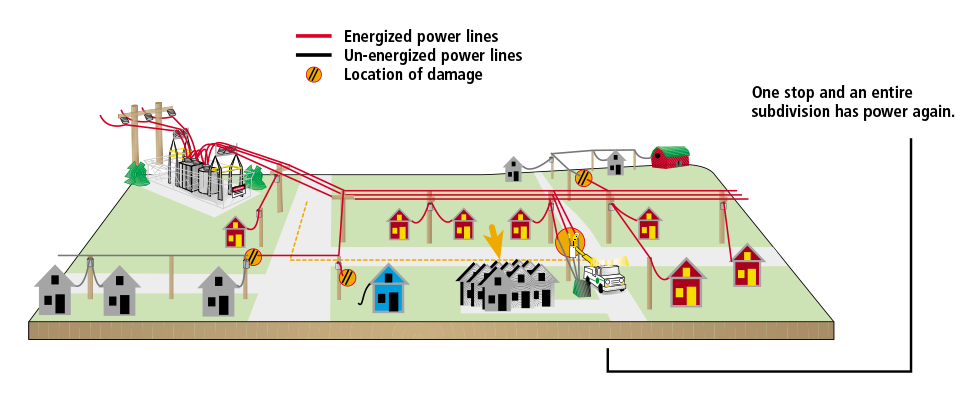
With the main line restored (now shown in red), the line crew can isolate other damage and prioritize repairs. Though a couple of repairs were closer, fixing the line that serves this subdivision down the road will get a larger number of consumers on more quickly.
Step 3
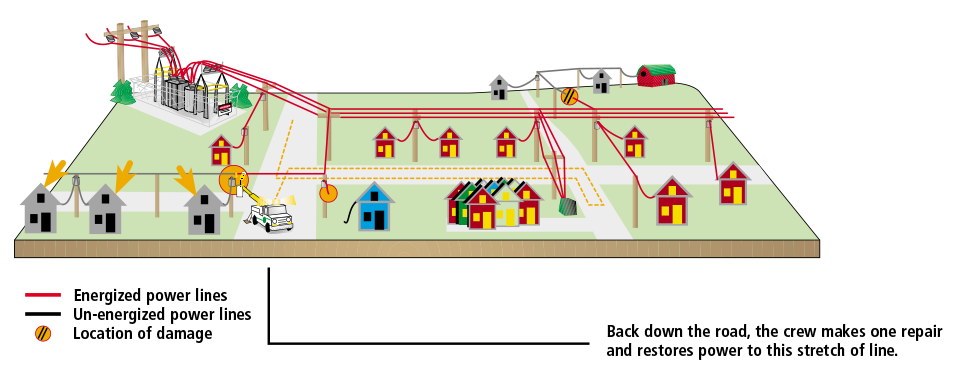
Moving back down the road to fix this tap line will restore electricity to the three homes marked with arrows.
Step 4
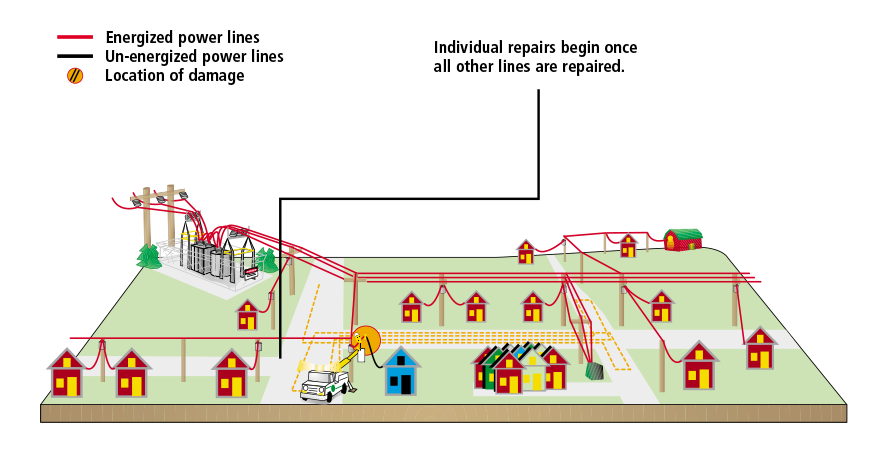
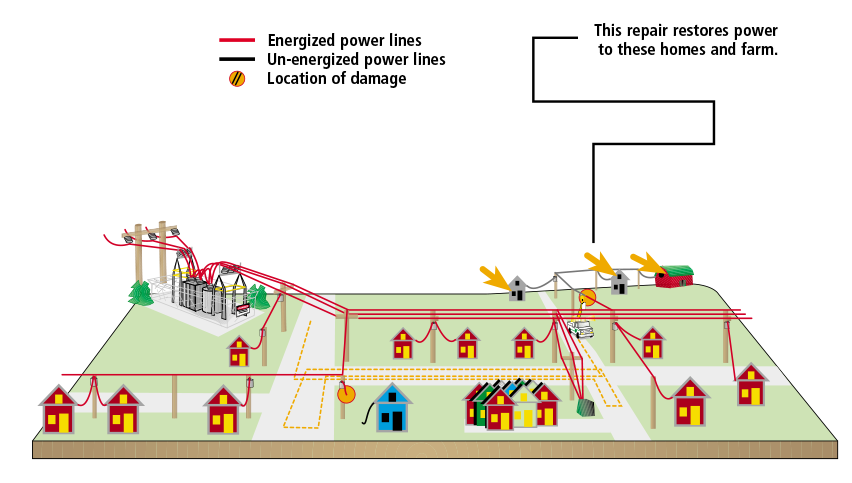
A smaller tap line serving a number of homes and the farm on the hill is next on the list for the line crew. The move probably doesn’t make the folks in the blue house too happy. They’ve seen the crew driving by their home and working right across the road. They see lights in homes of all their neighbors but they don’t have power. That’s because even though electricity is coming to their pole (that happened with the first repair in Step 1), the service line from their pole to their meter is damaged. Individual repairs come after all distribution and tap lines are restored.
Step 5
Only after the tap lines are repaired does the crew start work on individual service lines. The crew has been past the blue home three times and could have stopped to restore power anytime after the first main line was repaired and electricity was flowing to the pole nearby. But it’s not fair to other members for a crew to spend hours fixing one outage, when the crew can move down the road and restore power to dozens of homes in the same amount of time.